
Feel free to leave questions, comments, or ask for help!
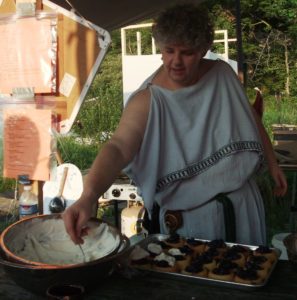
Culinary Historian
Learn about the art of cooking through the centuries. From the earliest days of human kind up to and including recipes for the modern home.

Chef Instructor
Christy has years of experience visiting the classroom to teach both young and old alike. She teaches in both traditional settings, either private or public school, as well as special settings (in home and abroad) for your educational needs.

Food News and Articles
For a wide range of articles on food, cooking, menus and dietary considerations, a vast library of culinary knowledge be sure to visit Christy's Blog for information, education and entertainment.
Given that rats produce their own vitamin C, if one were trying to ward off scurvy (say your pirate ship lacked limes), how could one use the rat in cooking to acquire the vitamin C? Would it be preserved in a stew? Would butchering the rat be okay or would consuming the entire animal or making a bone broth be needed? I suppose another important thing to know is if the vitamin C is stockpiled in the rat or if it’s made as needed, which might be worse for the at-risk-of-scurvy pirate chef.
Vitamin C is water-souluble, and much is lost during cooking. So short of Rat Squeezins (not a product I plan to launch anytime soon), I don’t think they’d be a great source.
Do you have a recommendation on a book that will explain the process of bread making? Why it is important to let it rise, how to tell if it has over risen? Is there a correction for over risen bread? How do you know how long to cook it. And what would impede the rise and why?
Bakewise by Shirley Corriher is very good at explaining the science behind the processes of baked goods.
Heya, Chef Christy, I need your help in jumpstarting my brain. Before the fire, I had a recipe for a bread which used neither corn nor wheat flour, but somewhat mimicked cornbread in mouth feel. My brain keeps saying it had to have been a lentil flour, but my gut says that’s not right. What are your thoughts on this conundrum, and do you have a recipe which would accomplish my goals?
On a separate note, I saw Amy’s question about Vitamin C in rats, and would love to know that answer, as well.
I’m going to make a guess that ‘besan’ or chick pea flour might give you the texture you are looking for.
Thank you very much! Chick pea might have been what it used. I think my sister has been using it for crusts. Either way. I’ll look for recipes using besan.
Hi there, I don’t know if you remember my mom and dad Chris and Jeanette Landin back when you were in Peach Curry but I am actually one of their children, Meg. I was wondering if i could possibly ask some questions from your perspective of the band and even if there is a way to get a CD again.
Hi Meg!
I’m happy to chat! Yes, I have copies of the CD still! 😃
Contact me here at: chefchristy@kingstaste.com
BTW – I am Friends with both of your parents on FB and actively participate in your dad’s Snow Pile contest every year. I haven’t won the Maple Syrup yet, but I’ll keep trying!
Hi Chef Christy,
I am writing on behalf of the Milton Historical Society. We are co-sponsoring a talk on John and Abigail Adams on January 13th, and I was looking for some ideas on a sweet treat that would have been popular during colonial days that we could offer to the lecture attendees. We will be making charcuterie cups, so ideally the treat would be something that could be skewered and placed in a charcuterie cut for individual service. I was thinking about gingerbread cubes or something along those lines. Thank you for any suggestions you may have.
Hi Mary! Confits like sugar-coated seeds were popular. If you have ever been to a Middle Eastern restaurant and they offered you candy-coated fennel seeds on your way out, you’ve had confits! Jordan Almonds are a larger version, and would be a nice ready-made addition. “Sugar Plums” would be from this period, and they can range all the way from a mixture of ground fruits and nuts to something more like a confit that is soaked and dipped and dried and dipped over and over. But something the texture of a Lara Bar made into balls and then rolled in sugar or cinnamon would be a good approximation. The Martha Washington Cookbook would be a great place to get ideas! Good luck!